Avery scholarship
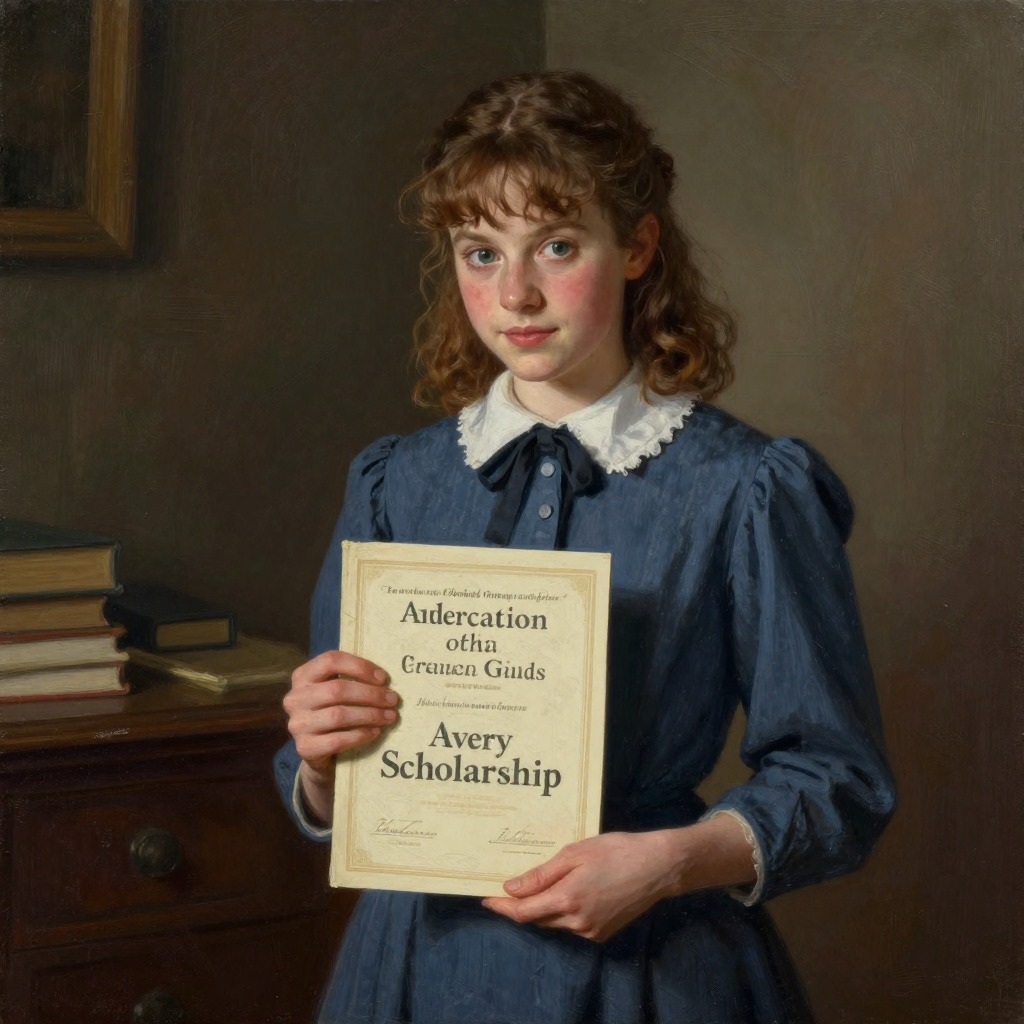
The Avery scholarship was a competitive academic prize established by a wealthy New Brunswick manufacturer who died and left part of his fortune to endow scholarships distributed among high schools and academies of the Maritime Provinces according to their respective standings. For Queen's Academy, the award carried a value of two hundred and fifty dollars per year for four years at Redmond College, granted to the graduate who achieved the highest mark in English and English Literature. When word reached Queen's that one of these scholarships would indeed be allotted to the institution, the news transformed the horizons of ambition for every serious student, but for none more than Anne Shirley.
Origin and Announcement
The Avery scholarship was first mentioned at Queen's Academy during Anne's winter term there. Josie Pye brought the news one evening, having learned it from Frank Stockley, whose uncle served on the board of governors. The announcement would be made officially at the Academy the following day. For Anne, the effect was immediate and electric: in a single moment she saw herself winning the Avery, taking an Arts course at Redmond College, and graduating in a gown and mortar board. The scholarship was in English, a subject where Anne felt her foot was on native heath, and she resolved that night that she would win it if hard work could accomplish the feat. "Wouldn't Matthew be proud if I got to be a B.A.?" she thought, and the glittering prospect gave her a new stock of ambition to fuel her studies through the demanding winter.
The Competition and the Victory
Throughout the winter term at Queen's, the Avery scholarship remained a prize that any one of a certain six students might win, with Emily Clay widely considered the likely victor. Anne worked with steady determination, her rivalry with Gilbert Blythe as intense as it had ever been in Avonlea school, though the bitterness had gone out of it. She no longer wished to win merely to defeat Gilbert, but for the proud consciousness of a well-won victory over a worthy foeman. When the final examination results were posted on the bulletin board at Queen's, Anne walked to the Academy with Jane Andrews, pale and quiet, having no hope of the Avery. She told Jane she lacked the moral courage to march up to the board and look at it before everybody, and asked Jane to read the announcements and come tell her. But as they went up the entrance steps, they found the hall full of boys carrying Gilbert Blythe around on their shoulders and shouting "Hurrah for Blythe, Medalist!" For a moment Anne felt one sickening pang of defeat and disappointment. Then somebody called out, "Three cheers for Miss Shirley, winner of the Avery!" Anne was pushed and pulled and hugged by a laughing, congratulating group, and managed to whisper to Jane that she must write the news home right away.
The Decision to Relinquish
Anne's triumph was shadowed almost immediately by tragedy. Matthew Cuthbert died of a heart attack brought on by news of the Abbey Bank failure, which wiped out the Cuthberts' savings. Shortly afterward, Marilla learned from an oculist that she would go stone-blind in six months unless she gave up all reading, sewing, and any work that strained her eyes. Faced with the prospect of Marilla losing both her sight and her home, Anne made her decision. The night after Marilla returned from town, Anne sat by her window in the darkness, looked her duty courageously in the face, and found it a friend. She told Marilla she was not going to Redmond and would not take the scholarship. "I'm just as ambitious as ever," she said. "Only, I've changed the object of my ambitions. I'm going to be a good teacher—and I'm going to save your eyesight." She planned to teach at the Carmody school, board at home, and study on her own. "When I left Queen's my future seemed to stretch out before me like a straight road," she reflected. "Now there is a bend in it. I don't know what lies around the bend, but I'm going to believe that the best does."
Significance
The Avery scholarship functions in the novel as the highest external validation of Anne's intellectual abilities, the reward for years of hard study and natural talent. That she wins it—tying with Gilbert Blythe for first place on the pass list and then capturing the English prize outright—confirms her transformation from the neglected orphan who could barely spell to a scholar of genuine distinction. Yet the scholarship's deeper narrative role lies in the choice it precipitates. Anne's decision to give up the Avery and stay at Green Gables is the culminating act of her moral growth, the moment when love and duty outweigh personal ambition. The scholarship, which had glittered as the summit of her dreams, becomes the measure of what she is willing to sacrifice. In renouncing it, Anne does not abandon her aspirations but redirects them, choosing a narrower path that she knows will bloom with flowers of quiet happiness. The Avery scholarship thus marks both the peak of Anne's academic achievement and the threshold of her adult life, where the bend in the road leads not away from Green Gables but more deeply into it.